
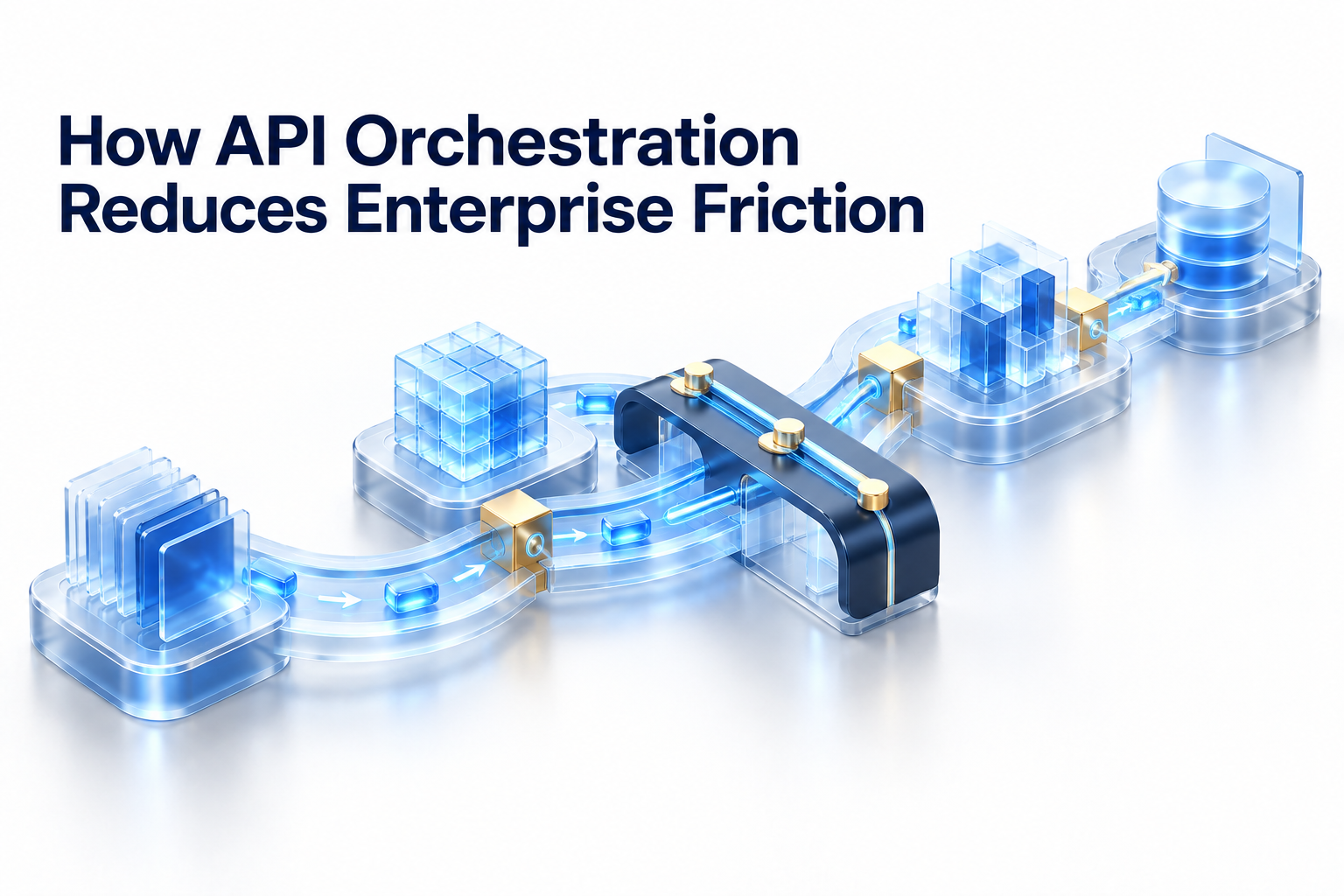
Most enterprises do not lack software. They have an ERP, CRM, ecommerce platform, identity provider, data systems, service applications, and a growing collection of partner tools. The friction appears when one business outcome depends on several of them working together.
An order crosses sales, inventory, finance, and fulfillment. A new partner needs access, pricing, data, and support. A customer request moves between internal teams and outside providers. When every handoff requires custom code, manual re-entry, or a person who knows the workaround, the systems may be connected without the business being coordinated.
The Direct Answer
API orchestration coordinates the sequence, data, rules, and failure handling required for multiple APIs to complete one business outcome. It allows internal systems and partner services to keep their defined responsibilities while a shared workflow manages how the pieces work together.
The value is not more API calls. The value is fewer disconnected steps for the customer, partner, employee, and business.
Done well, API orchestration can reduce manual handoffs, duplicated integration logic, partner-specific workarounds, and the time required to identify where a cross-system process failed. It creates one managed path through a process that would otherwise be scattered across applications and organizations.
What Is API Orchestration in Plain Language?
An API is an agreed way for software systems to request data or actions from one another. An integration connects systems. Orchestration coordinates several integrations so they operate as one business workflow.
An API gateway and an orchestration layer can work together, but they are not the same thing. A gateway commonly exposes endpoints, routes traffic, authenticates callers, applies policies, or combines responses. Orchestration manages the process: what happens first, what can happen in parallel, what decision comes next, and what to do when a step is delayed or fails.
Not every interaction needs a central orchestrator. Some event-driven processes are better handled through choreography, where independent systems respond to events without one component directing every step. Many enterprise environments need a thoughtful mix of synchronous APIs, asynchronous events, and durable workflows rather than one pattern for every problem.
Where Enterprise Friction Comes From
- Point-to-point sprawl. Each new system or partner adds another custom connection, and a change in one place creates work in several others.
- Inconsistent rules. Authentication, validation, data formats, error handling, and partner requirements are implemented differently across integrations.
- Hidden manual work. Employees copy data, reconcile exceptions, send status updates, or restart failed steps because the workflow is only partially connected.
- Limited visibility. Each system may report its own status, but no one can easily see the health of the full business transaction.
API orchestration addresses this coordination problem. It does not repair a weak API, unclear data ownership, or a broken business process by itself. The workflow still needs clear responsibilities and sound interfaces.
What Good API Orchestration Looks Like
- It Starts With a Business Journey
Begin with an outcome such as onboarding a partner, confirming an order, provisioning an account, or resolving a service request. Map the systems, decisions, handoffs, owners, and exceptions required to complete that outcome. This keeps the architecture tied to visible business friction instead of turning orchestration into another technology program. - It Uses Clear, Stable API Contracts
Each participating system should expose a defined contract for the data and actions it provides. The OpenAPI Specification provides a language-agnostic way to describe HTTP APIs so people and tools can understand how to interact with a service. Clear contracts, ownership, documentation, and versioning reduce the hidden assumptions that make integrations brittle. - It Keeps Business Responsibilities Clear
The orchestrator should coordinate the workflow, not absorb every system’s business logic or become the new source of truth. The ERP may still own orders, the identity platform may own accounts, and the carrier may own shipment status. Keeping those boundaries clear makes the workflow easier to change and support. - It Matches the Interaction to the Work
Use a synchronous request when the caller needs an immediate answer. Use asynchronous messaging or a durable workflow when processing will take longer, depend on outside parties, or continue after the original request ends. The architecture should make status visible without forcing a user or partner to wait on a long chain of systems. - It Designs for Failure and Recovery
Cross-system workflows will encounter timeouts, duplicate messages, unavailable services, invalid data, and partial completion. Good orchestration defines safe retries, timeouts, idempotent operations where appropriate, compensation or reversal steps, and a clear path for human review. Reliability is part of the workflow design, not an afterthought. - It Applies Security at Every Boundary
Internal applications, external partners, users, and machine identities should receive only the access required for their role. Authentication, authorization, validation, rate limits, secrets, and audit data need consistent ownership. A shared entry point can enforce common policies, but each downstream system must still protect its own responsibilities. - It Makes the Full Transaction Observable
Microsoft’s Gateway Aggregation guidance recommends collecting telemetry across the full request path because one client operation can depend on several backend calls. The same principle applies to broader orchestration: teams need a shared transaction or correlation ID, meaningful status, logs, metrics, and alerts that show where the business flow slowed or stopped.
What Could This Look Like in Practice?
In one past ILM engagement, account creation depended on a specific workflow involving an ERP system. ILM built an API that allowed other applications to submit the required user information through one shared service. The API handled the underlying account-creation workflow consistently instead of forcing every application to recreate it.
The same pattern can extend to a partner ecosystem. A distributor might submit one order request while the orchestration layer validates the partner, checks pricing and availability, creates the order, initiates fulfillment, and returns a useful status. Some steps may happen immediately. Others may continue asynchronously. If a dependency is unavailable, the workflow can retry safely or route the exception for review without asking the partner to understand the internal system landscape.
The partner receives one coherent experience. The enterprise preserves the systems that already do their jobs well. The orchestration layer manages the journey between them.
How Leaders Should Measure the Value
The number of APIs created is not the outcome. Measures should reflect whether a business journey became easier to complete, change, and support.
• Time required to onboard a new system, customer, supplier, or partner
• Manual handoffs, duplicate entry, and reconciliation steps removed
• Successful completion rate for the full business transaction
• Time required to identify and resolve cross-system exceptions
• Partner-specific code and duplicated integration logic reduced
• Time and effort required to change one participating system safely
Warning Signs the Orchestration Layer Is Creating More Friction
• The tool was selected before the team defined the business journey and its failure points.
• The orchestrator becomes a catchall for business logic that belongs in the participating systems.
• Every step is synchronous, creating long chains in which one slow dependency blocks the entire process.
• Retries can duplicate orders, payments, accounts, or other actions with business consequences.
• Partner-specific exceptions multiply because contracts, versioning, and reusable policies are unclear.
• Teams can monitor individual APIs but cannot trace the full transaction from request to outcome.
• A gateway is expected to solve workflow coordination, data ownership, and process design on its own.
• Partner access extends beyond what the role requires.
A Practical Five-Step Starting Plan
- Choose one high-friction journey
Select a process that crosses several systems or organizations and creates visible delay, rework, risk, or poor customer or partner experience. - Map the current path and exceptions
Document the systems of record, APIs, files, manual handoffs, decisions, owners, security boundaries, and common failure scenarios. Measure the current experience before changing it. - Define the contract and responsibilities
Decide what the shared workflow should expose, which system owns each decision and data element, and what remains outside the first release. Choose synchronous, asynchronous, or event-driven interactions based on the work. - Pilot the happy path and the failure paths
Test successful completion, slow dependencies, duplicate requests, invalid data, partial failures, access problems, and manual review. Add end-to-end tracing before production use. - Expand what proves reusable
Standardize the contracts, policies, monitoring, and workflow components that create value. Add more systems and partners when the first journey is reliable, owned, and measurable.
The Bottom Line
API orchestration reduces enterprise friction when it turns several technical interactions into one clear business journey. It helps existing platforms, custom applications, and partner services work together without making every user or integration understand the complexity underneath.
Start with the outcome. Keep responsibilities clear. Design for failure. Secure every boundary. Measure the complete transaction, not the number of endpoints.
Frequently Asked Questions
How Is API Orchestration Different From API Integration?
API integration connects systems so they can exchange data or actions. API orchestration coordinates multiple integrations as one workflow, including their sequence, decisions, state, and failure handling.
Is an API Gateway the Same as API Orchestration?
No. An API gateway typically provides a controlled entry point for routing, authentication, policies, rate limits, and sometimes response aggregation. Orchestration coordinates the business process across APIs and may use a gateway as one part of the architecture.
When Should an Enterprise Use API Orchestration?
API orchestration is worth considering when one important process spans several internal or partner systems, point-to-point integrations are becoming difficult to change, manual handoffs remain, or teams cannot see and recover the full transaction reliably.
Connect the Workflow, Not Just the Endpoints
If customers, employees, or partners are working around disconnected systems, ILM can help map the journey, clarify the integration architecture, and build a practical orchestration layer. Learn how custom applications and API integration layers can connect work, people, and systems, or connect with ILM to identify a high-value place to start.
Related ILM article: How to Fix Fragmented Data Before It Slows Analytics and AI