
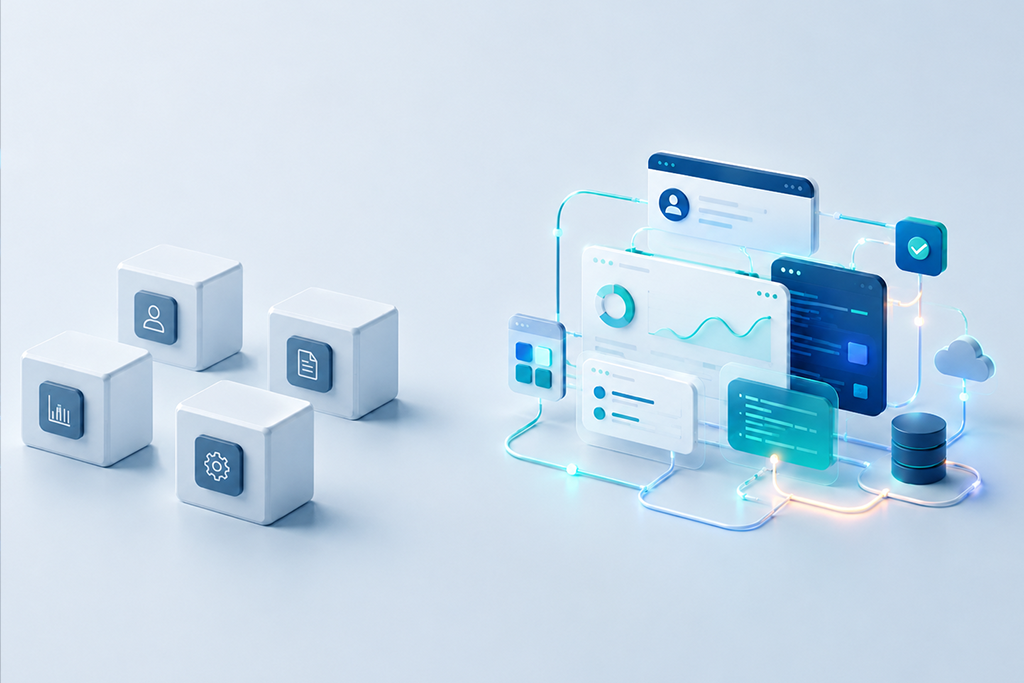
Custom applications create more value than packaged software when a business process is too specific, fragmented, integrated, or strategic to fit neatly inside an off-the-shelf tool.
Packaged software is often the right choice for standard needs. But when teams are forced to work across disconnected systems, acquired-company platforms, complex permissions, partner workflows, or unique customer experiences, a packaged tool can become another workaround instead of a solution.
The result is familiar: more tools, more handoffs, more duplicate work, and no single experience that fits how the business actually runs.
The better question is not “custom vs. packaged.”
The better question is:
Where does the business need standardization, and where does it need a system that reflects how the business actually works?
Packaged Software Is Not the Problem
Packaged software has a real place.
For common business functions, buying an existing platform is often faster, cheaper, and easier to support than building from scratch. Accounting, HR, CRM, email marketing, help desk, and project management tools are good examples. Most organizations do not need to custom-build those systems.
The problem begins when a packaged platform becomes the center of gravity for a workflow it was never designed to handle.
That is when teams begin creating workarounds:
- Exporting and re-importing spreadsheets
- Copying data between systems
- Managing approvals through email
- Maintaining multiple portals for different user groups
- Asking employees to log into several systems to complete one process
- Forcing acquired-company workflows into a tool that does not match the business
At that point, the organization may have software, but it does not have a connected operating model.
That distinction matters.
Digital transformation is not about adding more tools. It is about making work easier, more connected, and more useful to the people who rely on the system.
When Packaged Software Starts Creating Friction
A packaged platform usually works best when the business process is common and the organization can adapt to the tool.
Custom applications start making more sense when the opposite is true.
The business may have unique rules, multiple product lines, different customer types, partner-specific workflows, or internal systems that need to work together in ways a standard tool cannot easily support.
Common warning signs include:
- Several systems each contain part of the workflow
- Different business units use different tools after acquisitions
- Users need one experience, but the data lives in multiple places
- Off-the-shelf tools require heavy customization to get close to the desired process
- Employees still rely on spreadsheets, email, or manual handoffs after implementation
- Customer or partner experiences feel fragmented because the backend is fragmented
- The business needs more control over the roadmap than a vendor can provide
This is where custom application development can create more value.
Not because custom is automatically better. It is not.
Custom software creates value when it removes friction that packaged tools cannot realistically solve.
Creating a Connected Platform
In one engagement with a past ILM client, the business had acquired companies with different product lines serving different areas of the same industry. The work involved helping bring those services under one umbrella through a web application that could centralize information, manage users and permissions, support organizational structure, and connect data between entities.
The platform gave different acquired entities a way to work through a shared application. If one part of the business needed access to data from another part of the business, the application provided structured endpoints for sharing and using that information.
The goal was a more unified platform experience instead of a disconnected set of tools and systems.
That is the kind of situation where packaged software can struggle.
The issue was not simply, “We need a tool.”
The issue was, “We need a connected experience that reflects how our business is becoming more integrated.”
The Real Value Is Workflow Fit
A custom application should not simply digitize a messy process.
If the old process is fragmented, the new application should not make that fragmentation digital. It should clarify the workflow, reduce unnecessary handoffs, and create a better way for people to complete the work.
That starts with process understanding.
Before building anything, teams should answer:
- Who are the users?
- What are they trying to accomplish?
- Which steps are required?
- Which steps exist only because the current tools are disconnected?
- What data needs to move between systems?
- Who should be able to view, approve, edit, or share information?
- Which parts of the workflow should be standardized?
- Which parts need flexibility?
The value of custom software is not the code itself. The value is the fit between the application and the way the business needs to operate.
That is also where many projects go wrong.
When teams rush to build before clarifying the workflow, the application can become expensive, hard to use, and difficult to maintain. But when the workflow is clear, custom software can become the layer that connects people, systems, and data in a way packaged tools cannot.
APIs Often Make the Difference Between Another Tool and a Real Platform
Custom applications become especially valuable when they connect systems instead of replacing everything.
That is where API design matters.
The business point is simple: APIs help systems work together.
A custom application does not need to own every piece of data or replace every existing system. It can become an orchestration layer that connects the right systems, exposes the right workflows, and gives users a more unified experience.
In another ILM engagement, the team built an API to standardize user account creation across multiple applications. Previously, account creation required a specific workflow involving an ERP system. The new API allowed other applications to call one shared service, provide the necessary user information, and let the API handle the workflow consistently.
That is a practical example of why API orchestration matters.
Instead of making every application recreate the same process, the business can centralize the workflow and make it reusable.
When Custom Applications Are Worth Considering
A custom application is worth considering when at least one of these conditions is true.
- The process is a competitive differentiator
If the workflow is central to how the business creates value, forcing it into a generic platform may weaken what makes the business effective.
This does not mean every unique preference deserves custom software. It means the processes that shape customer experience, partner experience, operational efficiency, or product delivery deserve closer evaluation.
- Systems need to work together in a specific way
If the business depends on several systems, APIs, databases, partner tools, or acquired-company platforms, the work may require a connected application layer.
This is especially true when users need one experience, but the data lives across multiple systems.
- Users are stuck in manual handoffs
If people still rely on spreadsheets, email chains, copy/paste work, or manual reconciliation after a packaged platform is implemented, the tool may not be solving the actual workflow problem.
Custom software can help when it removes the manual review needed to connect systems.
- Data and permissions are more complex than the tool allows
Some organizations need role-based access, tenant-aware permissions, organization-level controls, or partner-specific visibility that does not fit neatly into a standard SaaS tool.
In those cases, forcing the process into the wrong platform can create security, usability, and governance issues.
- The roadmap needs more control
Packaged software ties the business to a vendor roadmap. That is fine for standard functions. But if the organization needs to move quickly, support a unique model, or build capabilities competitors do not have, custom development may provide more control.
When Packaged Software Is Still the Better Choice
Custom software should not be treated as the default answer.
Packaged software is often better when:
- The process is standard across many businesses
- The organization does not need heavy customization
- The tool already integrates well with the existing environment
- The business can adapt to the platform without major friction
- Speed and cost matter more than workflow uniqueness
- The capability is not strategic enough to justify ownership
A good technology partner should be honest about this.
The goal is not to build custom software for everything. The goal is to identify where custom work creates enough value to justify the investment.
A Practical Decision Framework
Before deciding whether to build, buy, or combine both, leaders should ask five questions.
- Is this workflow standard or unique?
If it is standard, packaged software may be enough. If it reflects how the business uniquely operates, custom may create more value. - How much integration is required?
If the system needs to connect several internal, vendor, or partner platforms, evaluate whether packaged software can support those integrations cleanly. - What happens if the process is forced into an existing tool?
Look for signs of future friction: manual workarounds, duplicate data entry, poor user adoption, or limits on future growth. - Who owns the experience?
If customers, partners, or internal teams need a seamless branded experience, a custom portal or workflow platform may be more appropriate. - What should be built now versus later?
Custom development does not have to mean a large first release. A focused MVP can validate the workflow, integration model, and user experience before expanding.
The right choice depends on the business outcome, not the tool category.
How ILM Helps
ILM helps organizations design and build digital platforms that connect work, people, and systems.
That can include custom business applications, workflow platforms, partner portals, API integration layers, and cloud-based application modernization.
The goal is not to replace every tool. The goal is to create a connected experience where packaged software alone cannot meet the business need.
For some clients, that means building a portal that brings multiple services into one place. For others, it means designing APIs that standardize a workflow across applications. For others, it means replacing manual handoffs with a more usable internal platform.
The best custom applications do not feel valuable because they are complicated.
They are valuable because they fit.
They help people complete the work faster, with less confusion, fewer disconnected steps, and better alignment between the technology and the business.
FAQ
When should a company build custom software instead of buying packaged software?
A company should consider custom software when the workflow is strategic, highly specific, integration-heavy, or difficult to support with an off-the-shelf tool.
Is custom software always better than packaged software?
No. Packaged software is often the better choice for standard business functions. Custom software creates value when the business process, user experience, or integration requirements are unique.
Can custom applications work with existing packaged software?
Yes. Many custom applications are designed to connect existing systems through APIs, portals, and workflow layers rather than replace every tool.
If your team is relying on disconnected tools, manual workarounds, or packaged software that no longer fits how the business operates, ILM can help you decide whether to build, buy, integrate, or modernize.