
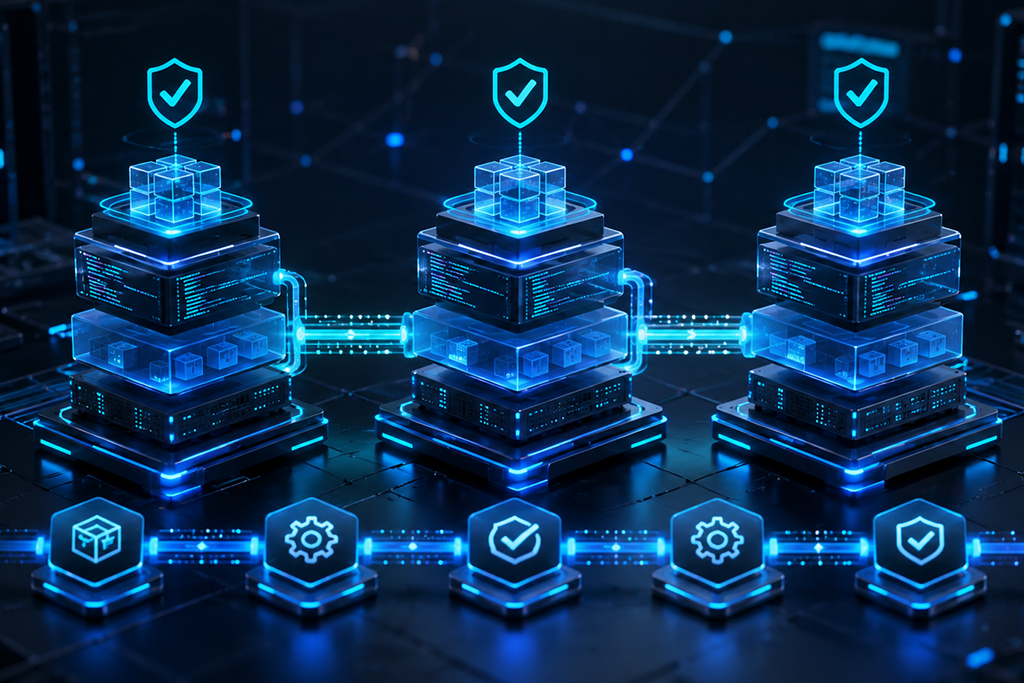
How to Reduce Environment Drift and Manual Deployment Risk
Environment drift happens when development, testing, and production systems become inconsistent over time. That inconsistency increases deployment risk, slows delivery, and makes software harder to maintain. The most effective way to reduce environment drift is to establish source control, automate builds and deployments, standardize shared components, and use infrastructure as code where it reduces risk.
For growing organizations, the issue is rarely developer effort. The real problem is the accumulation of undocumented processes, duplicated systems, and manual release habits that were never designed to scale.
Why Environment Drift Happens
Manual deployment risk rarely appears all at once.
It begins with practical decisions that seem harmless in the moment. A team copies code for one customer. A configuration is updated manually in production. A release depends on one person remembering the correct sequence of steps. A testing environment receives updates that never make it into production.
Over time, these decisions create divergence across environments, customer instances, and release paths.
That divergence is environment drift.
The result is not only technical complexity. It becomes a business issue. Features take longer to release, defects become harder to reproduce, and delivery timelines become less predictable. Leadership confidence declines because every deployment feels like a custom event instead of a repeatable process.
The Business Cost of Manual Deployment
Manual deployment processes often work in early stages because systems are smaller and teams are more tightly connected.
As organizations grow, those informal methods become liabilities.
Teams spend increasing amounts of time reconciling differences instead of improving the product. Customer-specific versions become difficult to maintain. Shared code is copied rather than reused. Releases require tribal knowledge that is not documented or easily transferred.
This creates three common outcomes:
- More engineering effort spent managing complexity
- Reduced confidence in testing and release quality
- Increased operational risk during deployments
In a past ILM project, the client maintained several customer-specific versions of its software. Each version had become its own copy of the code and was stored on a file server rather than in a modern source control system.
When shared functionality needed to be updated, changes had to be applied manually across multiple versions. Over time, the codebases drifted farther apart, making releases slower and increasing the cost of maintenance.
This is a common pattern in organizations that have grown faster than their delivery systems.
5 Practical Steps to Reduce Environment Drift
- Establish Source Control as the Source of Truth
The first step is not a major platform overhaul. It is creating a reliable source of truth.
Source control provides a shared, traceable system for managing application code, configuration, and change history. Without it, teams often rely on folders, local copies, or institutional memory to determine what changed.
That creates unnecessary risk.
With source control, teams can track changes, preserve history, and collaborate more effectively.
For organizations supporting multiple versions of an application, branching can help manage parallel workstreams without creating disconnected copies. The goal is not complexity. The goal is a clean structure that defines where stable code lives, where active development occurs, and how changes move toward release.
- Replace Manual Releases with CI/CD
Once source control is in place, the next priority is reducing manual release steps.
Continuous integration and continuous delivery, often referred to as CI/CD, help automate the path from code change to tested, deployable software.
This matters because automation creates consistency.
Instead of relying on individuals to remember every step, pipelines execute the same build, validation, and deployment sequence each time. If issues arise, teams identify them earlier in the process.
That repeatability reduces uncertainty and improves release confidence.
For one client, ILM introduced a CI/CD model where a code push triggered an automatic build. If successful, the application could then be deployed to a testing environment without manual intervention.
That created a more reliable path from code change to validation and reduced dependence on informal release processes.
- Standardize Shared Components
Environment drift is not only an infrastructure issue. It is often rooted in application design.
When teams duplicate code across customer-specific versions, shared logic becomes harder to maintain. Fixes applied in one version may never reach another. Over time, teams spend more effort reconciling differences than building new value.
A stronger approach is to identify what should remain shared and what should remain configurable.
That may include reusable libraries, common services, and configuration-driven behavior.
For mid-market teams, practical standardization can begin with:
• Shared repository structures
• Clear branching and release patterns
• Reusable build and deployment pipelines
• Environment configuration standards
• Documentation for how changes move from development to production
The objective is not additional process. It is making the consistent path easier than the manual workaround.
- Use Infrastructure as Code Where It Reduces Risk
As delivery practices mature, infrastructure becomes another major source of drift.
Manually configured environments often evolve in undocumented ways. A temporary change in one system may never be replicated elsewhere. A production issue may be difficult to reproduce because no one can easily verify how the infrastructure was defined.
Infrastructure as code reduces that risk by making infrastructure visible, versioned, and repeatable.
Rather than relying on manual setup, teams define infrastructure through code that can be reviewed, updated, and restored as needed.
ILM has used Terraform to support secure, repeatable infrastructure as part of broader performance and security improvement efforts.
That approach allowed infrastructure components to be created through code, versioned alongside application changes, and restored consistently if required.
- Make Delivery Visible
Teams cannot improve what they cannot see.
If releases are undocumented, inconsistent, or overly dependent on manual knowledge, problems often remain hidden until delivery slows or failures occur.
A stronger delivery foundation makes key questions easy to answer:
• What changed?
• Who approved it?
• Did the build pass?
• Were tests run?
• Which version is deployed?
• Are environments configured consistently?
• Can the team restore service if something fails?
This is where delivery discipline and observability begin to overlap.
Observability is often framed as a production monitoring capability, but visibility into the release process is equally important.
A Practical Roadmap for Teams
Reducing environment drift does not require changing everything at once.
A practical roadmap includes:
- Document the current release process
- Establish source control standards
- Automate build and validation steps
- Automate deployments where possible
- Codify infrastructure when manual changes create risk
For many organizations, the hardest challenge is not tooling. It is shifting from informal knowledge to shared operating discipline.
That transition is where outside expertise can accelerate progress.
How ILM Helps
ILM helps organizations modernize delivery foundations without forcing a one-size-fits-all transformation.
That may involve introducing source control and CI/CD practices, untangling duplicated codebases, or using infrastructure as code to create more consistent and recoverable environments.
The goal is the same in every case: reduce risk, improve release confidence, and give teams a stronger foundation for future modernization.
Manual deployment risk is not just a technical inconvenience. It is a business constraint.
When releases are fragile or inconsistent, the business cannot move as quickly as it needs to.
A stronger delivery foundation changes that.
If your team is managing manual deployments, duplicated codebases, or inconsistent environments, ILM can help identify the highest-risk friction points and build a practical path toward a stronger delivery foundation.